Independent concept · Kirill Naumov

Starbucks
Tomorrow.

Coffee timed to your arrival. Service built around your life.

Also known as Starbucks Reimagined. An independent concept, not commissioned by or affiliated with Starbucks. These are proposed mechanisms and a validation plan, not implementation results.

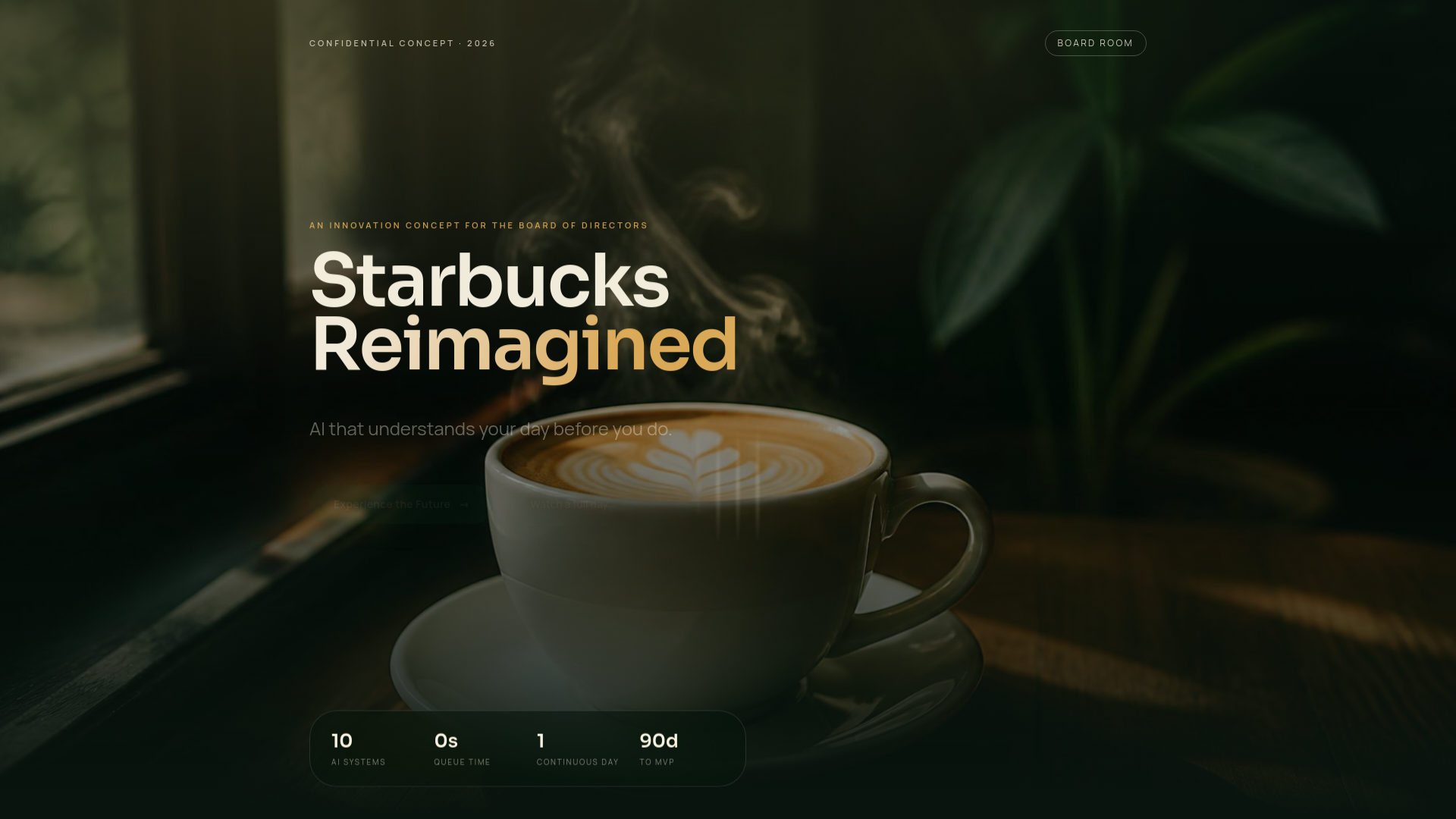
Archived Starbucks Reimagined concept visual: coffee and a proposed service interface
Original concept visual. Labels and controls within the image are illustrative, not a live interface or a performance promise.

Where it started

I kept burning my palate on cappuccino.

Perhaps the drink is meant to stay hot until I reach the car. That is my assumption, not a claim about Starbucks policy. But I want to drink it now. For me, this is where customer experience begins: the service anticipates one situation and the person arrives with another.

One person is late. Another needs ten drinks for the office. A third is choosing milk. Different needs, the same queue and service logic. Adding a chatbot does not, by itself, solve that problem.

Four mechanisms

Not AI for its own sake. A service redesign.

01 / AI Energy

Help me choose. Don’t make me study a menu.

Replace endless browsing with a short choice: preferences, constraints, drink now or takeaway. No health or mood inference from a face. Customers volunteer their preferences and can always open the full menu.

Measure time to order, purchase conversion and average order value. A higher basket must not depend on intrusive recommendations.
02 / Zero Queue

Manage the flow. Don’t promise zero seconds.

Connect preparation to expected arrival and actual bar capacity. Offer a realistic ready-time window, account for large orders and separate pickup from the till. Update the customer when delays occur; staff can override sequencing.

The aim is less pickup congestion, abandonment and drinks going cold. Track median and p90 waiting time, peak throughput, cancellations and waste.

03 / AI Barista

Context for the team. Attention for the guest.

Staff see priorities and confirmed preferences, not another stream of alerts. They can ask a question, correct an order or reject a recommendation. Approved quality and safety procedures govern temperature and preparation—not a free-form AI answer.

Track remakes, handoff accuracy, time per order and team workload. Faster must not mean harder for the barista.

04 / Service memory

The next purchase starts with the last one.

With permission, remember the usual order. Let the guest repeat or change it without rebuilding it. Offer something relevant to the visit, not an endless notification campaign. Guests can clear their history and switch personalisation off.

Hypothesis: convenience creates a reason to return without constant discounts. Compare 30-day repeat purchase, time between visits and margin—not just message opens.

Starbucks Tomorrow

Less friction.
More reasons to return.

An independent concept for a better customer experience.

Customer experience scenarios

Independent concept · 01/03

Coffee when you arrive.

Preparation is timed to your arrival. Orders are distributed around capacity, with pickup separate from the till queue.

Pilot measures: pickup waiting time and the share of customers leaving without ordering.

YOUR ORDER09:41

Your cappuccino will be ready when you arrive.

✓ Pickup without the till queue

Independent concept · 02/03

A better first sip.

Choose whether to drink now or take it away. That choice guides preparation, with quality and safety checked by the team.

Pilot measures: satisfaction with temperature and the frequency of remakes.

WHEN WILL YOU DRINK IT?Now

Prepared for your first sip, not a long wait.

✓ Preference saved with permission

Independent concept · 03/03

Next time, even simpler.

With permission, the service remembers your usual order. Repeat it without searching the menu again, with offers relevant to your visit.

Pilot measures: repeat purchase rate and time between visits.

YOUR USUALAgain?

Cappuccino. Just how you like it.

✓ Repeat your order

Not commissioned by Starbucks. Impact needs validation; these are not implementation results.

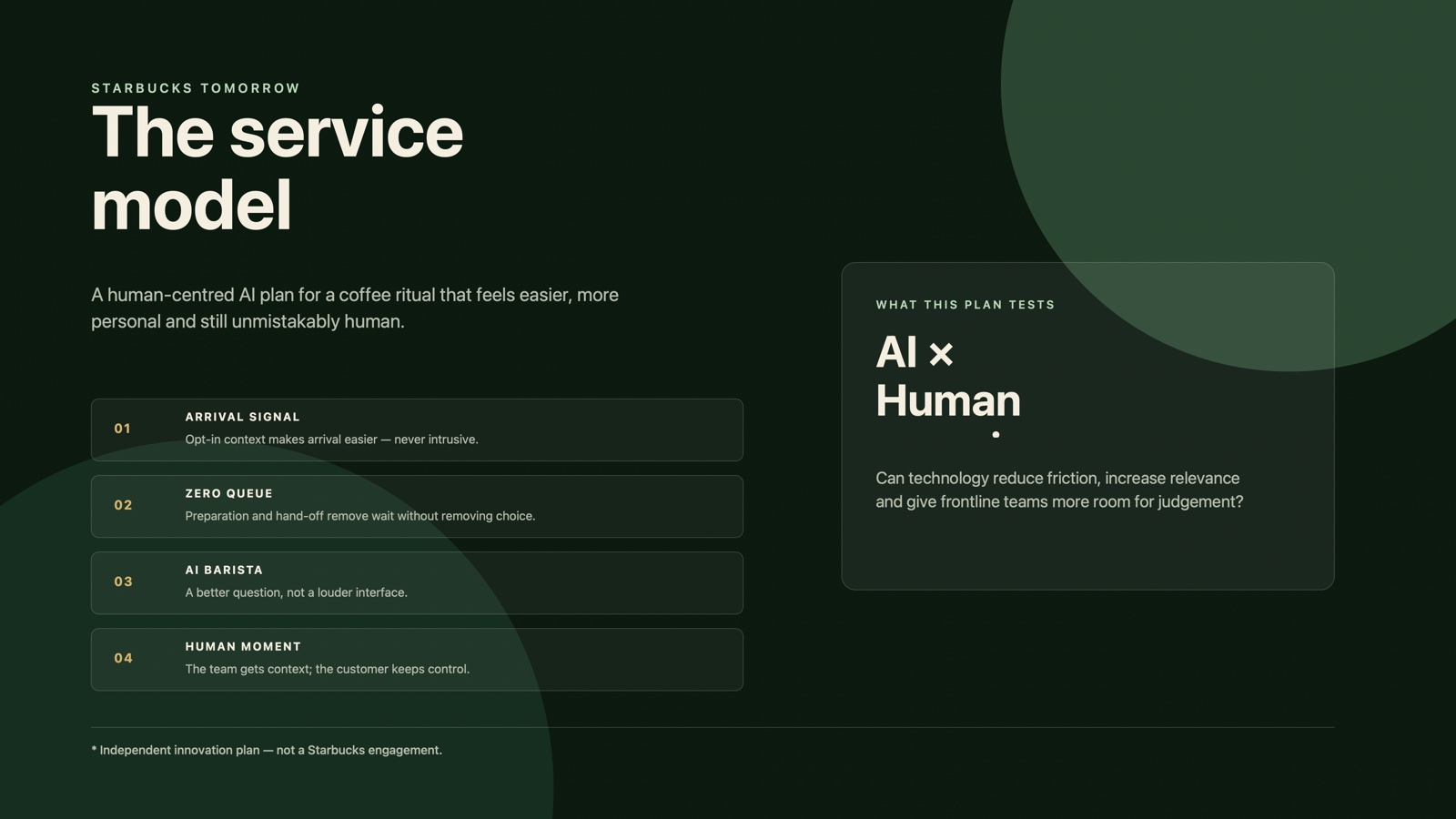
Service model: arrival, order flow, barista support and human attention
Preserved concept diagram. Mechanisms and measures are described above.

People × Operations

It will not work without the team.

For HR and L&D, circulating instructions is not adoption. Teams need short practice sessions in real shifts, clear decision rights and feedback without punishment for rejecting an AI suggestion. Operations owns flow and quality; commercial leadership owns repeat behaviour and economics; HR owns readiness to work differently.

Do not collect data just in case. Personalisation is optional and service remains available without a profile. Before a pilot, define retention, staff access and deletion. If the system fails, return to the normal process.

Proposed pilot · 90 days

Prove the value. Then scale.

01–30

Observe

Record the baseline, follow peak-hour customer journeys and listen to staff. Select one point of friction and agree consent rules.

31–60

Test

One scenario in one location with a small opt-in group. Train staff, assign an owner and retain the normal service as a fallback.

61–90

Decide

Compare matched shifts or a control group. Account for promotions, day of week and workload. Scale only when customer, team and commercial outcomes justify it.

Agree success thresholds against baseline data before launch. Stop if safety, quality or team workload deteriorates. No growth percentages are promised in advance.

How to measure an AI pilot →
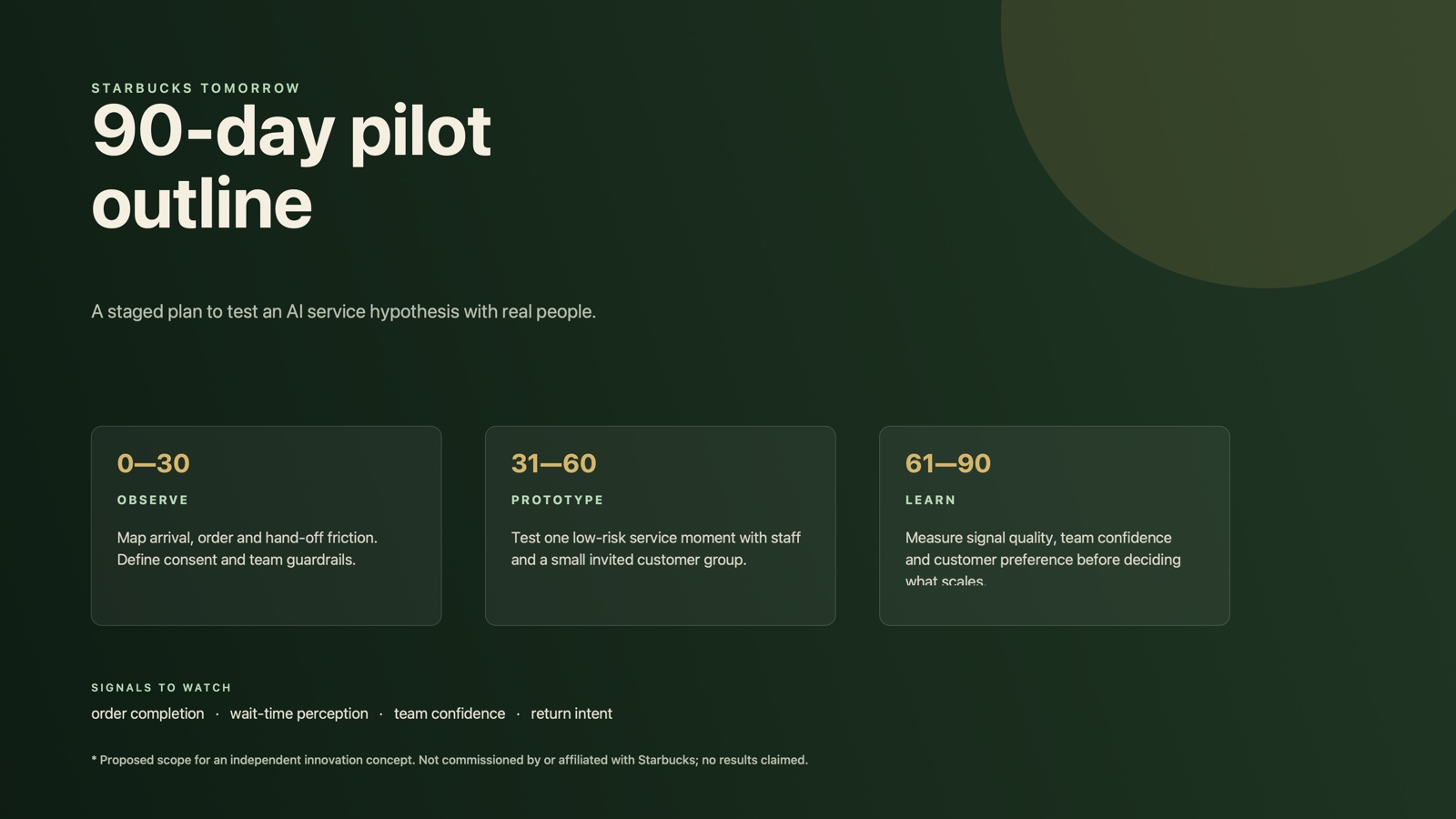
Archived pilot plan: observe, prototype and learn over 90 days
A proposed plan, not a report of a completed implementation.

Enterprise pilot

Test across selected locations. Scale across the network.

For large retail and service organisations. With your commercial, operations and HR teams, we identify one business challenge, agree pilot locations, baseline measures and criteria for a rollout decision.

The proposed pilot deliverables are a tested service scenario, a trained team and an assessment against baseline measures. Scope, timing and fees follow a discussion of your needs; the $500 diagnostic is neither a required entry step nor the pilot price.

The button opens a draft in your email app. You must send it yourself: clicking does not submit a request, book a meeting or take payment. If your email app does not open, contact: knaumoff10@gmail.com.